UK guide
IPTV subscription UK, no contract: what it covers and what it does not
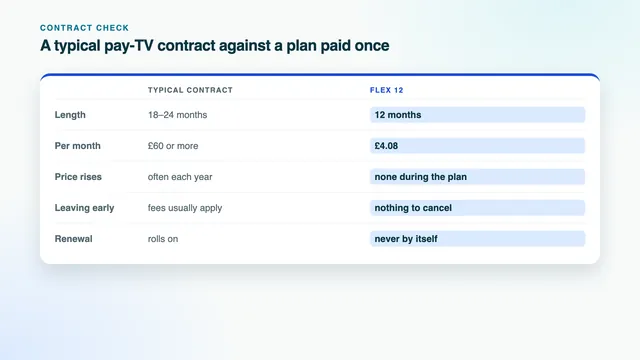
IPTV subscription UK, no contract: here, that means a set number of months paid for in one go, with nothing to sign, nothing taken from your account later and nothing that renews. This guide lists what the phrase covers line by line, sets it beside the way a typical pay-TV contract is built, and is just as plain about what it does not cover: a refund when you simply change your mind.
IPTV subscription UK, no contract: the short version
Most people who look this up have a pay-TV bill open in another tab. Their questions are practical ones. How long would I be tied in? What leaves my account each month? What does it cost to walk away? Each section below takes one of those questions and answers it with figures for both sides.
The phrase gets used loosely online, so it helps to pin it down. On this site, an IPTV subscription UK no contract plan is made of six concrete lines, and each one can be checked before you spend a penny.
Six lines that make up ‘no contract’
1. No minimum term
A pay-TV deal fixes a period you must stay for before you can leave without a charge. None of the four plans here has one, because there is nothing to stay in: the months you pay for are the months you get, and the plan simply runs out on its last day. Flex 3 is the shortest length on offer, so the smallest commitment you can make is £29.
2. No direct debit
You never hand over a sort code and account number. The payment is a single amount in pounds, made through a secure link the team sends you, and no card is kept on file afterwards. With no mandate in place, nothing can be drawn from your account later, whether by design or by mistake.
3. No credit check
Contract TV often begins with a search on your credit file, because the company is in effect lending you months of service and sometimes a box before you have paid for them. Here the whole length is settled before the login is sent. Nothing is lent, so no search is made.
4. No exit fee
An exit fee exists to recover months a customer still owes. A plan paid in full owes nothing, so stopping costs nothing and needs no form. If you stop watching in month five of Flex 12, no further sum is due; the remaining months just go unused.
5. No auto-renewal
When a plan reaches its end date, access stops and that is the whole story. There is no rollover onto a monthly rate, no notice period to serve and no reminder that quietly turns into a charge if you ignore it. To carry on, you place a fresh order, in the same way as the first.
6. An end date in writing
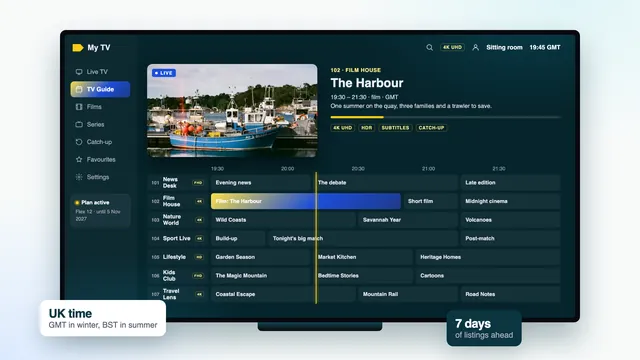
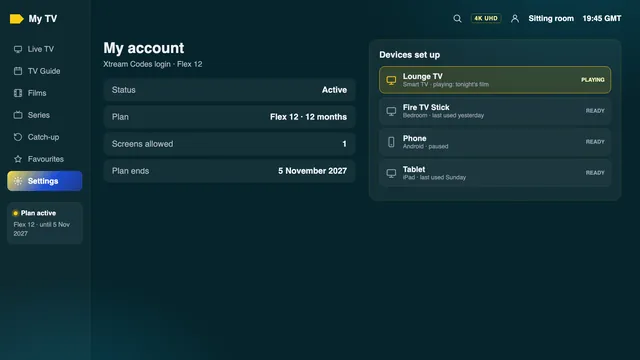
Inside the message you will find a username and a password, the server URL, a playlist address in M3U format, an XMLTV address that feeds the programme guide and, at the bottom, the day the plan ends. Most players built around the Xtream Codes login repeat that day on an account screen, so you can see how long remains without leaving the sofa.
How a typical pay-TV contract is put together
No company is named here, and terms vary from deal to deal. Read the list as the usual shape of a UK satellite or cable package that includes sport and films, at the time of writing, rather than as a quote:
- Length: you commit for 18 months, or for 24.
- Price: £60 or more a month once sport and films are included.
- Payment: a monthly direct debit, often after a credit search.
- Rises: the monthly price often goes up each year, inside the minimum term.
- Leaving early: a fee is usually charged to end the deal before the term is over.
- At the end: the deal rolls on, month after month, until you give notice.
- Equipment: a box that may have to be sent back when you leave.
| Line | Typical pay-TV contract | Flex 12 here |
|---|---|---|
| How long you are tied in | 18–24 months | not at all: 12 months paid, then it stops |
| What leaves your account monthly | £60 or more | nothing; £49 paid once (£4.08 a month) |
| How you pay | direct debit | a single card or PayPal payment |
| Search on your credit file | often | never |
| Price during the term | often rises each year | fixed, because it is paid before you start |
| Leaving early | a fee usually applies | nothing to pay and nothing to cancel |
| When the term ends | rolls on until you give notice | stops on the date in your message |
None of the lines on the left is a trick. They are how a contract pays for itself: a company that lends you a box and spreads the cost over two years needs a term, a regular debit and a way to recover what is still owed. An IPTV subscription UK no contract plan, settled up front, needs none of those, which is why they all drop away together.
The most each side can cost you
The fairest way to compare the two is the largest sum you could be asked for before you are free to walk away.
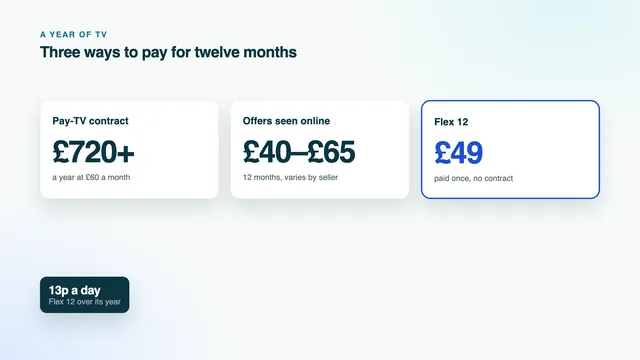
On a contract at £60 a month, an 18-month minimum term commits you to £1,080, and a 24-month term to £1,440, before any yearly rise. Those totals are floors: inside the term, the bill can only climb from there.
| Plan | Paid once: the most it can ever cost | What it covers | Per month |
|---|---|---|---|
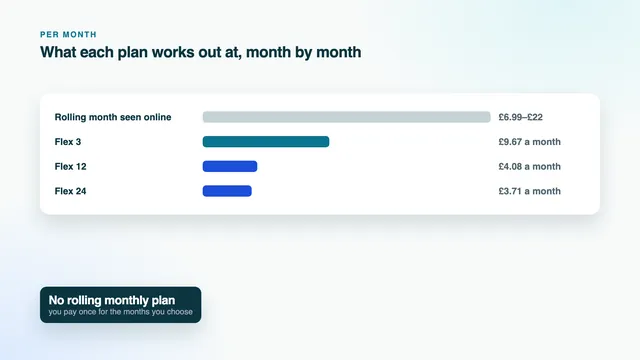
| Flex 3 | £29 | 3 months, one TV at a time | £9.67 |
| Flex 12 | £49 | 12 months, one TV at a time | £4.08 |
| Flex 12 Duo | £79 | 12 months, two TVs at once | £6.58 |
| Flex 24 | £89 | 24 months, one TV at a time | £3.71 |
Even the longest plan, Flex 24 at £89 for 24 months, comes to less than two months of a typical bundle. If you think in monthly amounts, the monthly figure for each plan breaks every price down that way, with one-month offers seen online set beside it.
Where the end date is written, and what happens on the day
Once the payment has gone through, the login message lands on WhatsApp or in your inbox within roughly 2 minutes, whatever the hour, with the end date included. Keep that message: it holds everything a new screen needs, and its date is the only renewal reminder you get.
On the last day
The player stops loading channels and the guide empties. Nothing is charged and nothing is needed from you. The apps stay installed on your devices; only the login stops working.
If you want more months
A further order works exactly like the first: pick a length, pay once, receive the details. They will be new details, typed into the same apps you already use, and the setup steps for each screen take a few minutes per device.
What ‘no contract’ does not mean
Paying once removes the lock-in. It does not turn the payment into a deposit you can reclaim whenever you like.
- Not a refund for any reason. The refund window is 7 days from payment, and it opens for two reasons alone: your details did not arrive, or the team’s help could not bring up a picture on any of your screens.
- Not a refund when your plans change. Finding after a week that you watch less TV than expected is not covered. Nor is a connection that turns out unable to carry 4K, when the speed it called for was explained up front.
- Not money back for unused months. Stopping early ends your viewing, not the payment. There is nothing to cancel because nothing is still running.
- Not extra screens. Flex 3, Flex 12 and Flex 24 each allow a single screen at once; Flex 12 Duo allows two.
- Not a login to pass around. A plan serves one household. Details shared beyond your own home, or put up online for others, risk being suspended.
- Not the same login for ever. A later order comes with new details.
Any refund is paid to whichever card or PayPal account you used. The full wording is in the refund policy, while our note on cancelling covers why nothing needs stopping when a plan ends.
Paying once: from the Buy button to the login
- Pick a length from the four plan cards and press Buy: a WhatsApp chat starts with the plan and its price written in, ready to send. Email works too: [email protected].
- The team answers with a secure payment link. Pay with a debit or credit card, or through PayPal; card numbers are entered on the payment company’s own page and never pass through the team.
- Your bank may want you to confirm the payment, usually through its app and sometimes with a texted code or a card reader. This step, Strong Customer Authentication (often called 3D Secure), covers most online card payments made in the UK.
- Roughly 2 minutes after the money clears, your details follow, at night as readily as by day.
If the bank declines, its fraud check has usually stepped in. Approving in the app, or a short call to the bank, tends to clear it, and the team can send the link again. The wording on your bank statement is chosen by the payment company, not by the team, who can tell you what to expect if you ask beforehand.
Your protection does not hang on a contract either. With a card, you can ask your card issuer for a chargeback, a request to pull back a payment for something you did not receive. Each bank sets its own deadline, often near 120 days, and expects you to have approached the seller before it steps in. Section 75 protection, from the Consumer Credit Act, starts only when a credit-card purchase passes £100, and stops at £30,000. Every plan here is priced under that line, so Section 75 does not come into it, while a chargeback request stays open to you. With PayPal, read PayPal’s own current terms.
Warning signs on any offer
No contract should never mean no rules. Before you settle on any IPTV subscription UK no contract offer, from anyone, stop and ask questions if:
- the only ways to pay are a bank transfer, gift cards or crypto;
- you are asked to send money through the PayPal option intended for paying people you know, not for purchases;
- the offer is called ‘lifetime’ and no end date appears in writing;
- the refund terms give no number of days, or there are none at all;
- a plain question sent before paying gets no reply;
- twelve months are advertised well under the £39.99–£65 range seen on offers online.
The answers here are short: card or PayPal, an end date in the message, 7 days written into the refund rule, and questions answered 24/7 in English before you spend anything. Send yours through the contact page, on WhatsApp or by email.
Picking a length when nothing locks you in
Without a term to weigh up, the choice comes down to how sure you are and how many TVs need a picture at the same time.
- Flex 3, £29 for three months: the way to see how the channels run on your own TV and line before putting down a year’s money.
- Flex 12, £49 for twelve months: the plan this site suggests, £4.08 a month and 13p a day.
- Flex 12 Duo, £79: two screens at the same time for twelve months.
- Flex 24, £89 for two years: the lowest figure per month, £3.71.
Whichever length you take, the channel list, the film and series library and the picture do not change: HD, Full HD, and 4K UHD where a programme was made in 4K. The IPTV subscription UK plans page lists each one with its end date and daily cost, and the IPTV subscription UK home page sets the suggested plan against a typical contract in its Contract check.
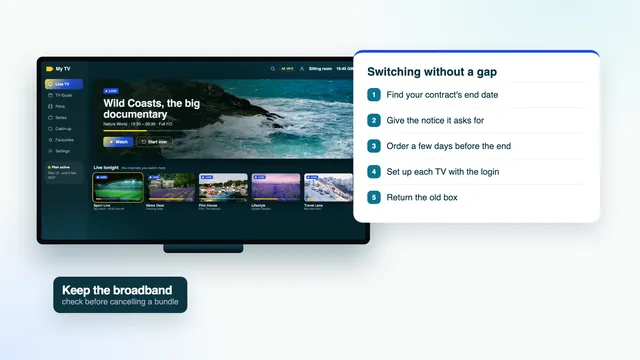
If you are still inside a pay-TV deal, leaving a pay-TV contract step by step covers finding your end date and giving notice. For a year in pounds, with offers seen online added, read what a year of viewing costs, priced three ways.
Frequently asked questions
Is there a minimum term on any plan?
No. Each plan is a fixed number of months paid in one go, and the shortest is Flex 3 at £29 for three months. There is no period you must stay for, because the plan simply ends on its date.
Will you ask for my bank details?
No. You never set up a direct debit or give a sort code and account number. You pay once through a secure link, with a card or through PayPal, and the card is not stored.
Do you run a credit check?
No. The whole plan is paid before the login is sent, so nothing is lent and nobody searches your credit file.
What happens when my plan ends?
Channels stop on the end date shown in your login message, and no charge follows. If you want more, a new order brings new details for the same apps.
Can I get money back for the months I have not used?
No. An IPTV subscription UK no contract plan has nothing to cancel, but that is different from a refund for unused months. Money comes back within 7 days of payment only if your details never came through, or if no screen would play despite the team’s help.
Can I start while I am still in a pay-TV contract?
Yes. The two are separate, so you can order a plan before the contract ends, see how it runs on your TV, and leave the contract on the date that costs you least. Any fee for leaving early is set by the contract’s own terms.