UK guide
IPTV Subscription UK Regional Channels: Nations, Regions and Local News
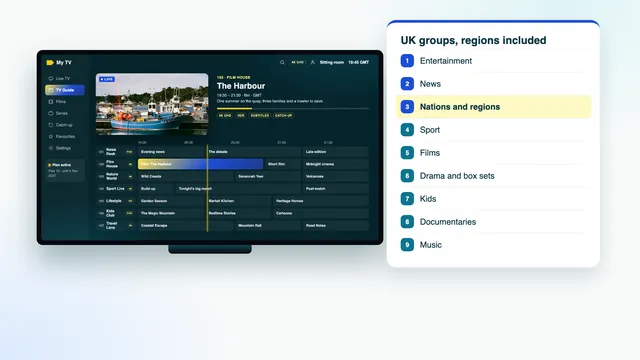
This guide to IPTV subscription UK regional channels shows where the nations and regions group sits in the channel list, how local news and weather reach your screen, and how to keep your own area one press away. Every plan carries the same list in the same order, with the British groups at the top and the regional group last among them. It is the one corner of the list that changes with where you live, so it pays to set it up once on each screen and then forget about it.
Where IPTV subscription UK regional channels sit in the list
The 40,000+ live channels that come with your login are sorted twice, by country first and then by category inside each country. The United Kingdom is at the top, so the British groups load before any other country’s when you open Live TV. Within the UK block the categories keep a set order, and the regional group closes it.
There is a reason for putting it last. On most evenings you want the general groups: a drama, the national news, a match. The regional group is the one you open with something specific in mind, such as tonight’s local bulletin, a forecast for the weekend or a programme made for your nation. Keeping it at the end of the British block means it never pushes the channels you use daily further down the screen.
| Order | UK group | What you will usually find there |
|---|---|---|
| 1 | Entertainment | The main national channels and general entertainment, on one schedule for the whole country |
| 2 | News | Rolling news and the national bulletins |
| 3 | Sport | Live matches, magazine shows and highlights |
| 4 | Films | Film channels, from recent releases to the classics |
| 5 | Drama and box sets | Series channels and long-running dramas |
| 6 | Kids | Channels for pre-school and older children |
| 7 | Documentaries | Nature, history, science and other factual channels |
| 8 | Music | Music video channels and radio-style streams |
| 9 | Nations and regions | Regional editions with local news and weather, and channels made for one nation |
Group names can read slightly differently from one player to the next, and a few players sort groups from A to Z unless you change it. If the regional group seems to have vanished, look at the sort setting before anything else: alphabetical order drops it into the middle of the list rather than at the end. Setting the sort back to its default puts the British block in its usual sequence again.
What the nations and regions group holds
Think of the group in two halves. The first is made of regional editions of national channels. For most of the day an edition carries the same network schedule as every other edition; at set points it swaps in its own local news, its own weather and, now and then, a programme made for that area. The second half, where the sources carry them, is made of channels built for one nation, with schedules of their own for much of the day.
IPTV subscription UK regional channels follow the same login, the same guide and the same picture rules as the rest of the list. Nothing extra is switched on and nothing is charged on top: the group is simply there, at the end of the British block, on every plan.
England’s regions
England is divided into several television regions, each with its own early-evening news programme and its own weather map. Editions tend to be labelled by area, such as the North West, the Midlands or the South West, rather than by town, so a home in a market town looks for the wider area it belongs to. Not sure which area covers your postcode? The local news on any edition answers within a minute, because the stories and the forecast are about the places it serves.
Scotland, Wales and Northern Ireland
Each nation has its own news service and, on several of the main channels, a schedule that departs from England’s for part of the day: a different evening programme, coverage of a home-nation match, or programmes in Welsh or Scottish Gaelic. In the list these editions usually carry the nation’s name, which makes them the easiest regional channels to find by search.
If you follow programmes in Welsh or Gaelic in particular, ask the team which editions the list carries today before you pay. The team answers in English, 24/7, on WhatsApp or by email, and a two-line question settles it.
Local news and weather: when it airs and how to catch it
Regional news on British television keeps a familiar rhythm: short bulletins after the national news at breakfast, at lunchtime and late in the evening, and a longer programme in the early evening. A local forecast follows most of them. None of that changes when the picture arrives through a login instead of an aerial; the slots stay where they were, in the same UK time.
What does change is that you choose the edition. The main version of a channel in the entertainment group carries whichever region its source takes, and that may not be yours. When the national bulletin ends and the local one begins, that version shows another area’s stories. For your own news, move to your area’s edition in the regional group a minute before the slot.
Missed the bulletin?
Catch-up runs on the channels that keep an archive, and that archive typically stretches back a week. Where your regional edition has one, yesterday’s early-evening programme sits in it like any other show: open the channel’s catch-up, go back to the day and the hour, and press play. Where an edition keeps no archive, the national version will not hold your bulletin either, because it never aired there. Our catch-up guide shows where the icon sits and what the player needs.
The local forecast
Local forecasts are short, often two or three minutes, and many guides fold them into the news entry rather than listing them on their own. They usually follow straight on from the local news, so a reminder on the news slot is the simplest way to catch them. On a winter morning, when you want to know about ice on the roads before the school run, that reminder earns its keep.
Finding your region in the guide
The guide that loads with your login covers seven days in UK time. On a list this size, the quickest route to IPTV subscription UK regional channels is to narrow the grid to their group before you start scrolling. In most players the steps look like this:
- Open Live TV and choose the United Kingdom at the top of the country list.
- Scroll to the last British group, nations and regions, and open it. If your player sorts groups from A to Z, look for it further up the list.
- Type the nation or the area into the Live TV search, for example Wales or North West, rather than a full channel name. Most players search channel titles, so an area name brings up every edition that carries it.
- Switch to the guide view with the regional group still selected. The grid now shows only the regional editions, side by side, each with its own line of programmes.
- Check the start of the local news against a clock. If every programme sits an hour away from where you expect it, change it with the EPG time offset, one hour either way. It tends to happen in the days after the spring or autumn clock change.
- Press and hold OK on your edition and add it to favourites. From then on it opens from the favourites row, without the search.
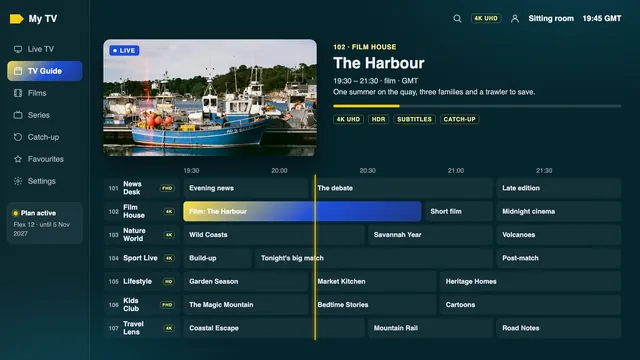
For more on the grid itself, on reminders and on the hour after the clocks change, read our guide to the seven-day listings in UK time.
A favourites list for your area
Favourites turn a list of 40,000+ channels into the dozen you actually watch. For regional viewing they matter more than anywhere else, because your edition shares most of its name with several others that look almost the same in the list. One press on the wrong line and you are watching the weather two hundred miles away.
Build it in this order
- Your edition first. The regional edition of the main channel you watch most, so the local news is the first thing under your thumb.
- Your nation’s own channels next, if you live in Scotland, Wales or Northern Ireland and the list carries them.
- One rolling news channel from the UK news group, for the national picture between local bulletins.
- The general channels you watch daily, from entertainment, drama and kids.
- A neighbouring edition, if you live near the edge of a region and its news covers where you work or shop.
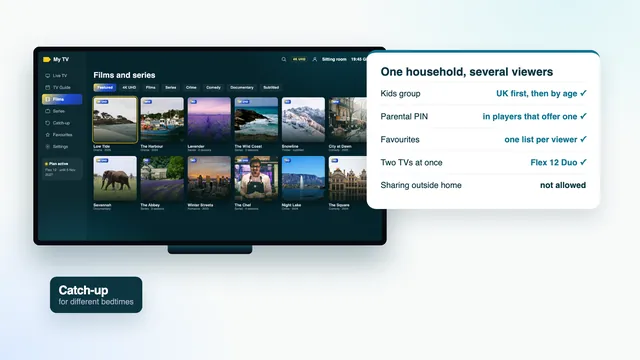
In most players favourites are stored in the app on that device, not in your login, so each screen keeps its own list. Set it up on the lounge TV first, then repeat it on the next screen. With Flex 12 Duo, the second room can keep a different list: the kitchen TV on local news and weather, the lounge on films. The guide for families covers lists for each viewer and the parental PIN.
Hide the groups you never open
Some players, TiviMate among them, let you hide whole groups or move them up and down. Hiding the other countries' groups and the British groups you never use leaves the regional group a couple of presses from the top. Nothing is deleted: a hidden group returns the moment you show it again, and the other screen on the same login keeps its own layout.
What varies by source
IPTV subscription UK regional channels are drawn from many sources, and they do not all behave alike. One edition can arrive in a different quality from its neighbour, with or without an archive, and with guide data that is more or less precise. These are the lines worth knowing about before you build a routine around one edition:
| What can differ | What you might notice | What to do |
|---|---|---|
| Picture quality | One edition in Full HD, the next in HD | Keep the sharper one in favourites when both cover your area |
| Catch-up | An archive on some editions, none on others | Look for the catch-up mark beside the channel before relying on it |
| Guide data | An edition showing the network schedule with no local slots | Go by the clock: local news airs at its usual time even when the guide line says otherwise |
| Labels | Area names, short forms or a nation in front of the name | Search by area or nation instead of the full label |
| Editions listed | An edition added, renamed or replaced | If a favourite stops loading, search the area again and save the new entry |
| Order in the player | The group moved by an A to Z sort | Set group sorting back to default |
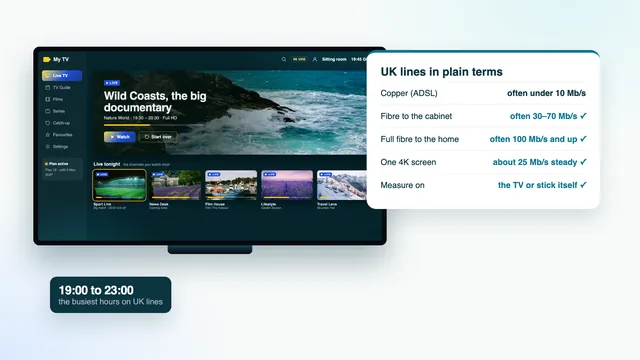
Speed is rarely the problem here. A Full HD edition asks for around 10 Mb/s, steady, measured on the device that plays it; an HD edition about half that. If the local news stutters at half past six while the rest of the evening plays cleanly, the broadband guide explains what the early evening does to a UK line and how to read a speed check on the TV itself.
Aerial, contract or login: how your region is chosen
With an aerial, your region follows the transmitter the aerial points at. That is why homes near a boundary sometimes get the next county’s news, and why turning the aerial a few degrees can change the bulletin you see. On a typical pay-TV contract, the regional edition is usually set from the address on the account and moves only when the account does.
With a login, nothing is fixed to a mast or an address. You open the group and choose. People who live on a boundary often keep two editions in favourites and pick whichever bulletin covers the town they are heading to that day; families who moved from one nation to another keep the news from home a press away.
That freedom has one sensible limit. The login belongs to one household, so the choice is about the edition that suits your home, not about sharing a plan with relatives elsewhere in the country. Using it at another address, or putting it online for others, can get it suspended.
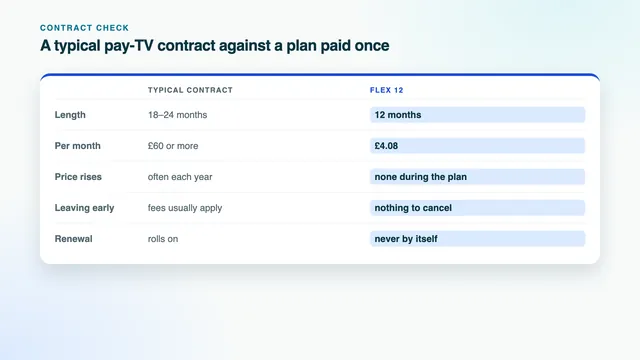
Moving house is simpler too. There is no account address to update and no visit to book: you pick a different edition from the same group, on the same login, until the end date written in your login message. If a contract stands between you and that, the guide to leaving a pay-TV contract lists the end date to find and the notice to give.
Choosing a plan for regional viewing
Every plan carries the same channel list, IPTV subscription UK regional channels included, with the same picture quality and the same guide. What sets the plans apart is the number of months and how many TVs can watch at once, and each is paid once. With an IPTV subscription UK homes take without a contract, the end date sits in your login message and nothing renews by itself.
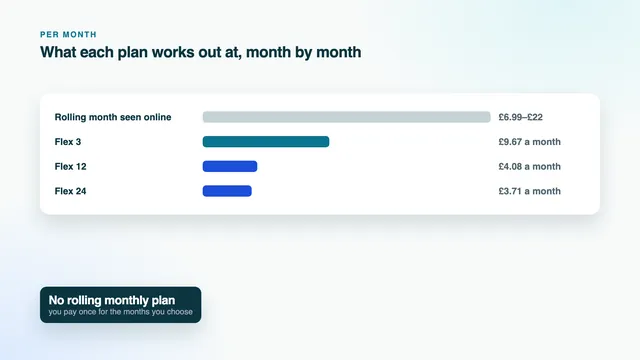
- Flex 3: 3 months, £29 paid once, £9.67 a month across the plan, 1 screen.
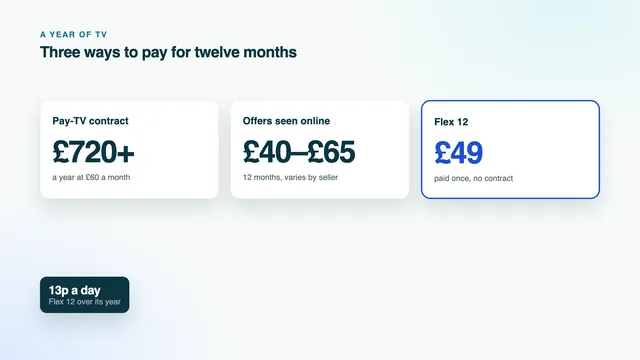
- Flex 12: 12 months, £49 paid once, £4.08 a month across the plan, 1 screen.
- Flex 12 Duo: 12 months, £79 paid once, £6.58 a month across the plan, 2 screens at the same time.
- Flex 24: 24 months, £89 paid once, £3.71 a month across the plan, 1 screen.
For most homes Flex 12 is the one we suggest: £49 for a year, about 13p a day. If two rooms watch at once, perhaps the local news in the kitchen while the lounge watches something else, Flex 12 Duo covers both. Compare them side by side in the four plans, or open the plans page with each end date before you choose.
Once the card or PayPal payment clears, the login message is in your WhatsApp chat or inbox within about 2 minutes. The setup guide covers every step between that message and a working picture; the regional group is then ten minutes of the steps above, once per screen.
Frequently asked questions
Are the IPTV subscription UK regional channels the same on every plan?
Yes. Flex 3, Flex 12, Flex 12 Duo and Flex 24 carry the same channel list in the same order, with the nations and regions group last among the British groups. Only the months and the number of TVs watching at once change from plan to plan.
Why does the guide show a network programme while my local news is on?
Some editions take their guide data from the national listing, which has no local slots in it. The local news still airs at its usual time; the guide line simply does not show it. Go by the clock, or keep a reminder on the slot before.
Can I watch another region’s news?
Yes. Open that area’s edition in the regional group: a login is not tied to a postcode or a transmitter. Many people near a boundary keep two editions in favourites.
Is there an edition for Scotland, Wales and Northern Ireland?
Each nation usually has editions of its own in the nations and regions group, often labelled with the nation’s name. How they are grouped depends on the sources and the player, so search by the nation’s name to see them all at once.
Does local news have catch-up?
It does when your regional edition keeps an archive, which normally reaches a week into the past. The catch-up mark beside the channel tells you. An edition without an archive cannot offer last night’s bulletin, and the national version will not have it.
My regional edition stopped loading. What should I do?
Search the area name again: an edition is sometimes renamed or replaced, and the old favourite then points nowhere. If nothing for your area plays, send the team the edition’s name and the time, and they will look into it.