UK guide
IPTV subscription UK family viewing: kids, PINs, favourites and two TVs
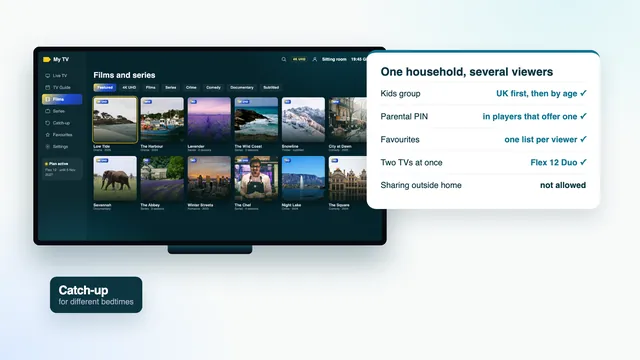
An IPTV subscription UK family home runs on one login shared by the people who live under one roof: parents, children and perhaps a grandparent who lives with you. This guide covers what makes that work from one day to the next: the kids group in the channel list, a parental PIN on the groups younger children should not open, a favourites list for each viewer, two TVs at once when the lounge and a bedroom both want the screen, and catch-up for programmes that air after bedtime. It ends with the rule that keeps the login inside the household.
IPTV subscription UK family viewing: who watches what, and where
Before touching a setting, sketch your household’s week. Who watches in the lounge, who has a TV, stick or tablet in a bedroom, and which evenings two people want different things at the same moment. The answers settle three questions: how many screens need to play at once, which groups need a lock, and whose favourites belong on which device.
| Time | Lounge TV | Bedroom TV or tablet | Screens playing |
|---|---|---|---|
| 16:30–18:00 | Children’s programmes from the kids group | Off | 1 |
| 18:00–19:30 | The news during tea | A series from the library, for the teenager | 2 |
| 19:30–21:00 | The parents catch up on last night’s drama | Football on a sport channel | 2 |
| 21:00–23:00 | A film for the adults | Off, in theory | 1 |
If your sketch never shows two screens at the same moment, a one-screen plan is enough. The login can sit in the player on several devices in the home, and whichever one is playing has the stream; only one plays at any moment. If two evenings a week show two screens, the section on two TVs below helps you choose.

The kids group in the channel list and the library
The live list is arranged country by country and then by theme, with the British groups at the top: kids, entertainment, drama and box sets, films, sport, news, documentaries, music and the regional channels. The kids group brings the children’s channels together, so a young viewer can be shown one short group instead of 40,000 channels. In an IPTV subscription UK family home, that group is the first thing to put within easy reach.
On demand, 120,000 films and series sit in a library with categories of its own, most of them in English and the rest subtitled. Children’s and family titles usually have categories of their own there too. Posters and summaries help you choose, but they are no substitute for an adult glance before a film night with younger children.
Put the kids group first
Many players let you reorder groups, and some let you hide the ones you never open. On the lounge TV, move the kids group to the top, beside the favourites. On a child’s own tablet, hide what they have no reason to scroll through, such as news from other countries, late film categories and sport, so the list they see is short and theirs.
The 9 pm watershed stops at the border
On British broadcast TV, programmes unsuitable for children are held back until after 9 pm. That is a rule for UK broadcasters. Channels from other countries follow their own customs, and catch-up and the library play any title at any hour of the day. On a family TV, the PIN described next takes over the job the watershed does for live UK channels.
Parental PINs: in the player and on the device
There are two layers of lock, and an IPTV subscription UK family TV is best served by both: one inside the player, guarding particular groups, and one on the device, guarding the player itself.
In the player, where it offers one
Full-featured players, IPTV Smarters Pro and TiviMate among them, include a parental-control setting: you choose a PIN, then mark the groups or categories it should guard. A child who opens a locked group meets a PIN prompt instead of a list of channels. Menus move between versions, so look in the settings for “Parental control”, “Lock” or a padlock icon. Some players keep the option in a paid tier, and simple ones such as VLC have no lock at all.
The lock is normally stored by the app on that one device rather than carried by the login. A PIN set on the lounge TV does nothing on the bedroom stick or the kitchen tablet, so set it on every device a child can reach.
On the TV, stick or box
The device adds a second layer. On Fire TV devices, Settings › Preferences › Parental Controls can ask for a PIN before apps open, which keeps a younger child out of the player entirely. Apple TV has Settings › General › Restrictions, guarded by a passcode, and Google TV lets you add a children’s profile that shows only the apps you pick. Most smart TVs have an app lock of their own in the settings menu, under a name that varies by brand.
What a PIN cannot do
A PIN guards the groups you tick and nothing else. It does not judge the programmes inside an unlocked group, and a group added to the list later may arrive unlocked, so look over the lock settings every few months. Pick a number the children have never watched you type, and change it the day they have.
A favourites list for each viewer
With 40,000 live channels, favourites are how a family finds its way around. In most players you highlight a channel and hold the OK button, or open its menu, to add a star or a heart, and the favourites group then sits at the top of the list.
Favourites are usually stored in the app on each device rather than in the login, and in a family that is handy. The lounge TV can hold the channels everyone shares, the teenager’s stick the sport and music, the kitchen tablet the news and the cookery programmes. Each device opens on its owner’s list.
On a single shared TV, look in the player’s settings for profiles or for several favourites lists; some players offer them, others keep one list for everybody. With only one list, a fixed order keeps the peace: children’s channels first, then the shared ones, then each adult’s short selection. Ten to fifteen channels per person is plenty, because a list that grows to sixty has become another channel list to scroll through.
Favourites in the programme guide
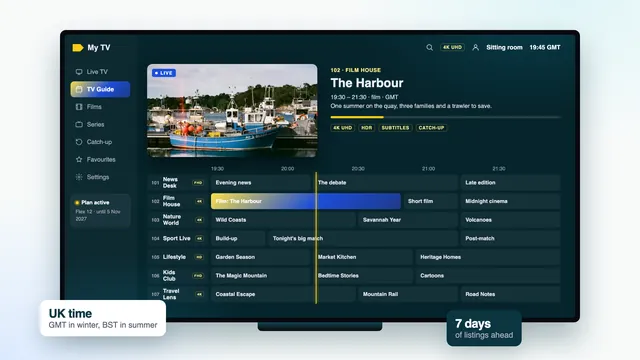
In many players the seven-day guide can show the favourites group on its own, which turns a wall of listings into one evening’s choice for your household. The guide to the seven-day TV listings explains how the listings load and how to fix the hour after the clocks change.
Two TVs at once: one screen or Flex 12 Duo
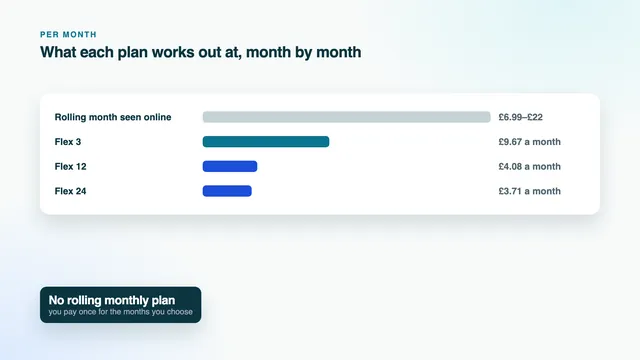
Flex 3, Flex 12 and Flex 24 each allow a single screen at any moment. Flex 12 Duo plays on two at the same time for £79 a year, which is £6.58 a month across the plan. Channels, library and picture quality are identical in all four; the only differences are length and screen count.
| Your household | Plan that fits | Why |
|---|---|---|
| One main TV; everyone watches together or takes turns | Flex 12 | One screen at a time is enough, at £4.08 a month |
| Two TVs often playing on the same evening | Flex 12 Duo | Two screens at once, all year, under one login |
| Not sure yet how the family will use it | Flex 3 | 3 months for £29, then order again if it suits |
| One screen, and settled for longer | Flex 24 | The lowest cost a month, £3.71 |
Flex 12 Duo costs £19 less than two separate Flex 12 plans, and it keeps both rooms on one login with one end date. With two screens going, the line carries both streams: roughly 20 Mb/s for a pair of Full HD pictures, and roughly 35 for 4K in the lounge alongside Full HD upstairs. The broadband guide for UK homes shows how to read that on a busy evening.
On a one-screen plan, agree a house rule rather than arguing at kick-off: the lounge has priority on match nights, say, and the bedroom TV plays whenever the lounge is off. Just one picture can run, so the rule settles whose turn it is.
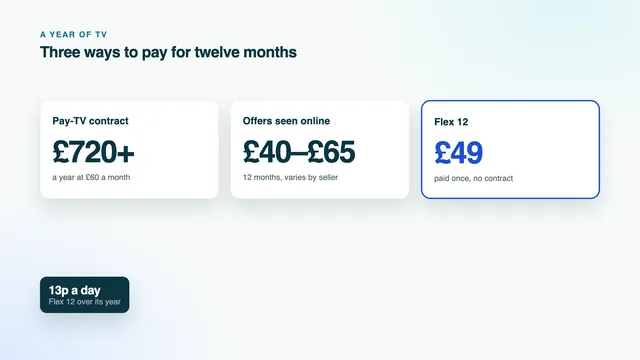
Prices and screens sit side by side in the four plans, and the plans page works each one out per month and per day.
Catch-up for different bedtimes
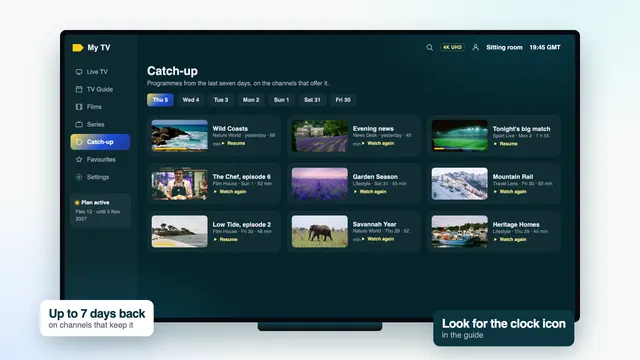
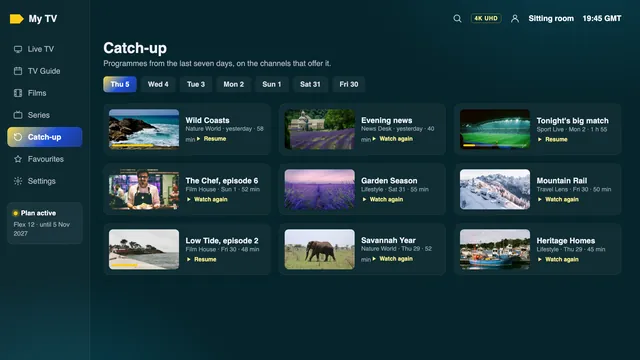
IPTV subscription UK family viewing rarely runs on one timetable. A five-year-old is asleep by seven, a teenager wants the programme the whole class will talk about tomorrow, and the adults' drama starts at nine. Catch-up takes most of the friction out: where a channel keeps its programmes, they can be replayed for up to seven days.
- The 18:00 children’s programme missed at bath time plays the next afternoon, straight from the guide.
- A series that airs during homework waits for the weekend.
- The 21:00 drama starts from the beginning at 21:45, once the house is quiet.
- A match that finishes after a child’s bedtime plays the next morning, as long as nobody mentions the score at breakfast.
In most players, channels with catch-up carry a small clock or rewind mark. Open the guide, step back to the day, choose the programme and press OK. Catch-up uses a stream just as live TV does, so on a one-screen plan a catch-up in the bedroom is the screen in use.
Listings are shown in UK time, which means GMT through the winter and BST from late March to late October. If the times look an hour adrift after the clocks go forward or back, adjust the EPG time offset in the player’s settings. The catch-up guide covers which channels keep programmes and what the player needs.
The one-household rule, in plain words
Every plan is for one household: the people who live at your address and watch on its screens. Should the login be passed to people outside the home, or put up somewhere public, it can be suspended, and that switches off every screen in the house, not only the one belonging to whoever passed it on.
In practice, a grown-up son or daughter in their own flat, grandparents in their own house and a student living away at university each form another household, with a plan of their own. A grandparent who lives with you is part of yours. That boundary is what keeps an IPTV subscription UK family set-up running without interruptions.
Children’s phones deserve the same care. A younger child never needs the login, because an adult types it into each device once; an older child can be shown where the player is without being handed the message itself.
A family set-up in one evening
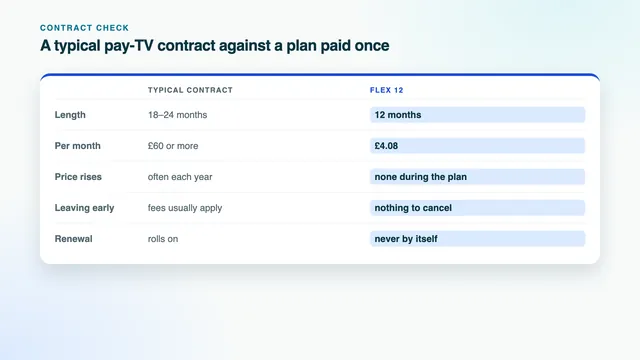
- Order the plan that matches your sketch. The IPTV subscription UK home page sets each one against a typical pay-TV contract, and the login message follows about 2 minutes after payment.
- Install a player on each TV, stick and tablet in the house and type in the login; the setup guide goes through it screen by screen.
- Set the parental PIN in the player on every device a child uses, and tick the groups to lock.
- Add the device’s own lock wherever a younger child should not open the player at all.
- Move the kids group to the top and build a short favourites list per person or per device.
- Check that the guide shows UK time, and show the older children where catch-up lives.
- Write the end date from the login message somewhere the adults will see it.
There is no contract and no direct debit: the plan simply stops on its end date, with nothing renewing, so nobody finds a surprise on the bank statement. Coming back later means placing a fresh order, after which you receive a new login to enter in the same apps; check afterwards that the PIN and the favourites are still in place, since some players tie them to the login. The guide to watching with no contract explains the end date in full.
If anyone gets stuck, from a group that will not lock to a tablet that will not log in, write to the team through the contact page; answers come in English, 24/7.
Frequently asked questions
Can everyone at home use one plan?
Yes, everyone who lives in your household. Flex 3, Flex 12 and Flex 24 allow one screen at any moment, and Flex 12 Duo allows two. Relatives in their own homes need a plan of their own.
Is there a parental PIN?
The PIN lives in the player rather than in the login. Players like TiviMate and IPTV Smarters Pro offer a parental-control setting where you choose a PIN and lock groups. Fire TV, Apple TV and Google TV add their own locks on the device.
Can each child have their own favourites?
Yes, most simply by device, since favourites are usually stored in the app on each TV, stick or tablet. On one shared TV, use the player’s profiles if it has them, or keep a single list in a fixed order.
What if two of us want to watch at the same time on a one-screen plan?
On Flex 3, Flex 12 and Flex 24, a single picture plays at any moment. If two rooms clash most weeks, Flex 12 Duo plays on two TVs at once for £79 a year. Otherwise a house rule, with catch-up for whoever waits, does the job.
Are there children’s films and series?
Yes. Among the 120,000 titles on demand, children’s and family films and series usually sit in categories of their own, and the live list has a kids group among the UK channels. Lock the other categories on a younger child’s device if the player allows it.
Can the children watch what aired after their bedtime?
Yes, wherever a channel offers catch-up, its programmes stay available for up to seven days. Open the guide, go back to the day and choose the programme. On a one-screen plan, catch-up uses the screen just as live TV does.
Can grandparents in another house use our login?
No. A plan covers one household, and a login used outside it can be suspended, which cuts off your own screens too. Grandparents in their own home need a plan of their own.